The Scheme Proposals and Construction

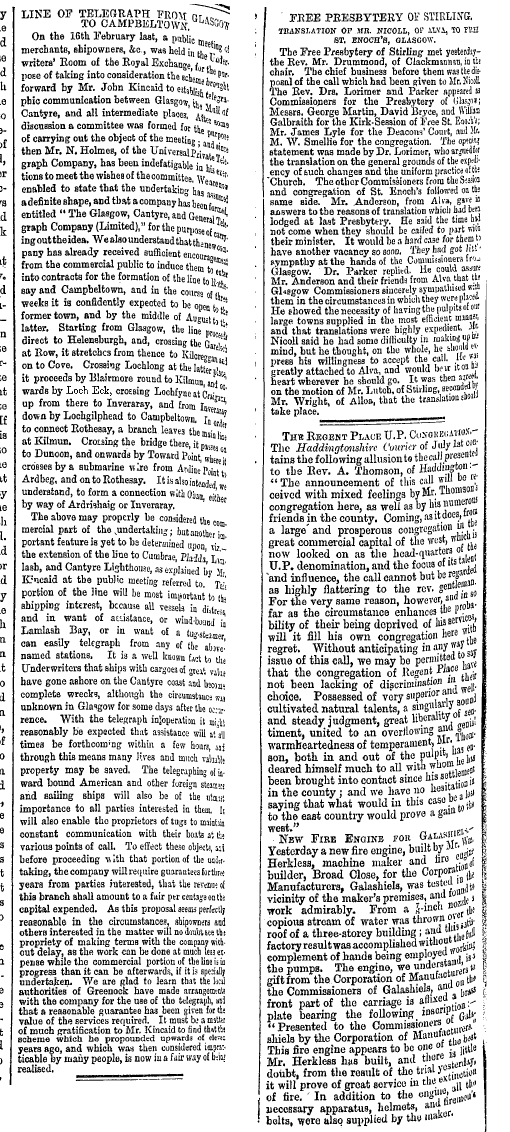
The line was built in 1864 and 1865 for the Universal Private Telegraph Company (UPTC) by Reid Brothers of London, around the time the land was surveyed by Ordnance Survey. This partly explains why the telegraph lines are shown on some sheets of the first edition OS map and not on others. The public telegraph was formally opened on 4 September 1865 by an exchange of telegrams between John Cameron, chairman of UPTC in Glasgow and the Duke of Argyll in Campbeltown. The route was used by two separate systems. There was a private telegraph for the shipping industry, connecting the Glasgow office to the Mull of Kintyre lighthouse, and a public service serving the telegraph offices listed above.
The Universal Private Telegraph Company
In June 1858 Charles Wheatstone patented electric telegraph instruments that overcame both these problems. He called his invention the universal telegraph. After 1880, when patent ownership was transferred to the Post Office, the instruments were renamed the ABC telegraph.

The instrument comprised two dials, the smaller one being the receiver and the larger one being part of the transmitter. The larger dial was surrounded by keys, one for each letter. There was a hand driven magneto which was used to generate the electrical code for the selected letter. Thus, if you could read you could send and receive messages, and there was no requirement to work with the dangerous batteries of the day.
The Universal Private Telegraph Company was founded in June 1861 to work the patents for the Universal telegraph. The West Highland telegraph was a trading name of UPTC. The company was nationalised in 1870, when it was taken over by the Post Office.
The Private Telegraph
…….. it had also been contemplated to erect a signal post at Cantyre and another at Pladda, to be employed in the same way as the signal now erected at Roche’s Point, (which is at the entrance to Cork Harbour in Ireland) by which the Cunard steamers and other vessels were sighted. Of course the facilities that signal-post would give would be such that vessels could be communicated with after they had left Glasgow, and information connected with their cargoes and other matters could arrive in Glasgow many hours before information could otherwise be obtained.
He further added:
The Universal Private Telegraph Company would have their own station at Cantyre,
….. and in Glasgow the messages which would be private and confidential would be delivered to the parties for whom they were sent.
Three sections of the Glasgow-based shipping interests supported the private telegraph system; the tugmasters, the shipowners and the underwriters.
The Tugmasters’ Interests
At present there are about 25 tugs engaged in the towing of vessels on the Clyde. Now, in consequence of there being no communication by telegraph to Cantyre and the entrance to the North Channel these tugs are at present obliged to keep knocking about day and night, and often for days together, without having anything to do. If this scheme is carried out, forming a connection as far down as the Cantyre light, it would be quite possible for those tugs to be lying in such places as Campbeltown Bay or Lamlash Bay, ready to go out when required. In this way the proprietors of those tugs would be much better enabled to control the management of them in sending them out in search of vessels, and he thought it would be a very simple matter indeed to show that even if the proprietors of those tugs were to come under a guarantee for the great bulk of the sum required in this case it would be a very great saving indeed. He thought it would be a very simple matter to show that in regard to tear and wear, consumption of fuel, and other things connected with the management of them, the telegraph would be of the utmost benefit to the proprietors of those tugs.
Loss of life, ships and cargoes at this time was huge. On 25 February 1867 the Glasgow Herald reported The number of wrecks reported during the past week amounted to 41; making for the present year a total of 601. The National Institution for the Preservation of Life from Shipwreck had been established in 1824 to establish lifeboats and crews, and lifeboat stations, where required, to reduce the loss of life. The name was changed to the Royal National Lifeboat Institution in 1854. It was the job of the tugmasters and their tugs to salvage the shipwrecks and their cargoes.
The Shipowners’ Interests
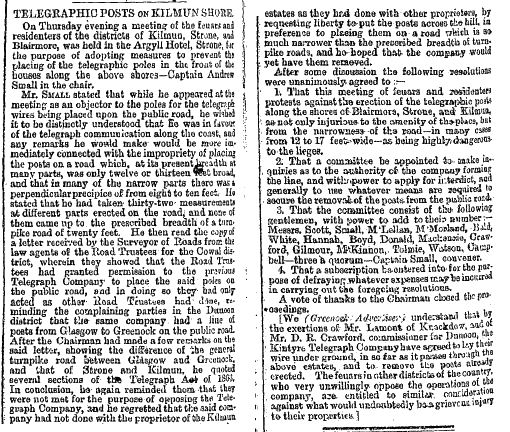
None of the the above systems required the use of submarine cables, but the Glasgow system would require four submarine cable sections; one across Gare Loch between Rhu and Rosneath, one across Loch Long between Cove and Blairmore, one across the Kyles of Bute between Ardyne Point and Ardbeg and one across Loch Fyne between Creggans Point and Creaggan. The shipping interests in Glasgow considered it was not until 1864 that submarine cables were sufficiently robust to provide a reliable system. Even so, the cables were liable to abuse by vandals and the anchors of fishing vessels, as described in a piece in the Glasgow Herald of 12 September 1867.
MALICIOUS DAMAGE TO THE WEST HIGHLAND TELEGRAPH WIRES.-
The Ordnance Gazetteer of Scotland (Groome), in the paragraph describing Blairmore, reported:
The telegraph cable communicating with the W. Highlands lies from it to Cove; was broken in Dec. 1870; and, ten days after being broken was successfully grappled and repaired.
Thus, damage to submarine cables was a problem, but it was manageable.
The Underwriters’ Interests
In the previous ten years there had been several very considerable wrecks on the coast in question. The character of these wrecks was not known in Glasgow in some cases for two days after the event. Had the private telegraph been in place and working, tugs lying in Campbeltown Bay or at Lamlash could have been despatched in a couple of hours to assist the wrecked vessels. Much valuable property might have been saved, possibly sufficient to keep the telegraph going for a very long time.