| Up a level | ||||||||||
 |
 |
 |
 |
 |
 |
 |
 |
 |
 |
 |
| Argentina | Bolivia | Chile | Colombia | Costa Rica | Cuba | Dominican Rep. | Ecuador | El Salvador | Guatemala | Honduras |
| Up a level | ||||||||||
 |
 |
 |
 |
 |
 |
 |
 |
 |
 |
 |
| Mexico | Morocco | Guinea | Nicaragua | Panama | Paraguay | Peru | Philippines | Puerto Rico | Uruguay | Venezuela |
| Different Sections : | |||||
| 5 Pesos of 1890 | 1 Pesos Submarinos - Warren | My Comments | Other Candidates | Moens 1898 | Another suspicious item |
Philippines Telegraphic Forgeries.
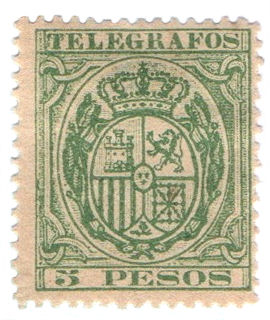
The most well known one is the 5 Pesos of 1890 mentioned by Steve Hiscocks.
 |
 |
| Genuine H48 Courtesy of Les Bottomley |
H48a (forgery) used in Manila Courtesy of SoleryLlach |
The H48 forgey shown above appears to have suffered a partial colour change. This may indicate that the ink used for it was not colour-fast and changed when soaking it off.
If you should be lucky enough to get one of these, don't soak it !
An article by Christian Preuße, published in the first quarter 2024 Philippine Philatelic Journal, describes this forgery.
It appears to be lithographed and has thicker frame lines and poor quality printing on poor quality paper.
Notably the serifs on "T" of "TELEGRAFOS" are much longer and it is perf. 13 rather than perf.14.
Dates range from April to July 1890. The authorities became aware of it 12 July and all the 5P were withdrawn by decree. Hence the subsequent 5P in blue.
Note that this is not the first forgery to defraud the Government, in 1885 the dumb idea of surcharging 2½c postage stamps as 1 Pesos Submarine Telegraph stamps
was a temptation too lucrative to pass up. Hiscocks H10a and H11a were a result of that.
There have also been others. However there has also been forgeries intended to defraud the collector.
Strangely, though these were documented from 1938 in the Philippines, the information does not appear to have spread beyond those islands. Until now anyway.
The range of variety of the 1 Pesos Submarine Telegraph stamps was noticed and described though by Moens in 1898, including H10a and H11a.
On the Types of "HABILITADO TELEGRAMAS SUBMARINOS 1 PESO.” by Arnold H. Warren, 1938.
Only the fact that very few collectors are interested in telegraph stamps can account for the existence of at least eleven unlisted varieties of one of the most common
of Philippine telegraph stamps. This stamp is catalogued by Yvert as No. 10, by Galvez as Nos. 10, 11, 12 and 13, and by Messrs. Palmer, Bartels and Foster as Nos. 13 and 13a.
It is the 2⁴͏/͏₈c. postage stamp of 1882 surcharged in red "HABILITADO TELEGRAMAS SUBMARINOS 1 PESO.” The postage stamp itself exists in three types, Scott’s Nos. 78, 79, and 80,
which are distinguished by minute yet recognizable differences. Galvez designates these three types of the stamp as: Type I (Scott's No. 78); type II (Scott's No. 79); and type III (Scott's No. 80).
These stamps will be referred to hereafter as types I, II and III, as described by Galvez.
Of the surcharge two types only are listed. These are vaguely described as “large” and “small” by both Palmer and Galvez.
Palmer lists each type of the surcharge as occuring on only one type (Type II) of the stamp.
Palmer also lists the “small” type of the surcharge on the authority of another catalogue and does not himself vouch for its existence. The writer is therefore forced to conclude that Palmer,
altho a painstaking student of Philippine postage stamps, never made any study of Philippine telegraph stamps.
Galvez lists both the “large” and the “small” types of the surcharge as occuring on two types (Types II and III) of the stamp, making in all four varieties of the telegraph stamp
which are listed by Galvez.
In attempting to identify the four varieties listed by Galvez the writer has discovered that there are at least eight types of the surcharge,
some of which occur on three types of the stamp, and one of which is said to be a forgery which was made to defraud the Government and was actually used in large quantities for telegraph purposes.
The writer also discovered two types of forgery which were evidently made to deceive the stamp collector.
VARIETIES ENCOUNTERED
The writer has examined nearly four thousand specimens of this surcharged stamp and has classified these both as to type of surcharge and as to type of stamp on which the surcharge occurs.
In listing these the writer starts with No. 10, the first number given to this stamp by Galvez. The writer's No. 10, is not, however, the same variety of the stamp as that listed by Galvez as No. 10.
The types of surcharge included in the writer's list. are described hereafter.
2⁴͏/͏₈c. Ultramarine Postage Stamp of 1882 surcharged in red.
HABILITADO TELEGRAMAS SUBMARINOS 1 PESO

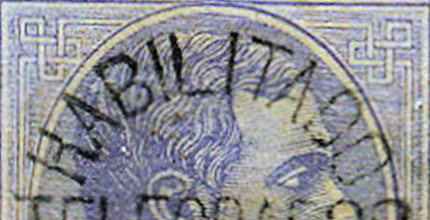
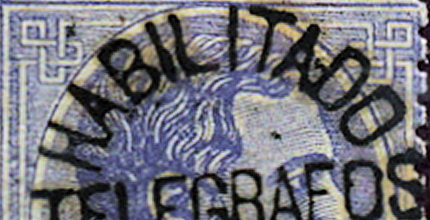
The writer believes, after a careful inspection of the two illustrations of this surcharge appearing in Galvez’ Catalogo Especial de los Sellos de España, Colonias y Ex Colonias, that
Galvez’ No. 10 is the writer's No. 11A; that Galvez’ No. 11 is the writer's No. 11A, a; that Galvez’ No. 12 is the writer's No. 12A; that Galvez, No. 13 [type 7 on stamp type III]
the writer has not seen and therefore does not list; but if the writer should see a specimen of Galvez’ No. 13, the writer would list it as No. 12A, a.
TYPES OF SURCHARGE DESCRIBED
TYPE 1. The H of Habilitado is above the T of Telegramas. The word Submarinos is about 15.5 mm. long. The B of Submarinos is narrower than the B of Habilitado.
The O of Submarinos is very narrow. The letter O is in all cases rather rectangular in shape. The middle bar of the R is above the center of the letter.
The lines of the letters are thin. The ink used was a bright red and was evidently very “thick” because the letters when examined under a glass appear
to be “raised” above the surface of the paper. This surcharge is very common on type II of the stamp and is rare on type I of the stamp.
TYPE 2. This surcharge is very similar to type 1 in general appearance, and might easily be confused with type 1. Many of the letters of type 2 are noticeably wider than the same letters of type 1.
Note particularly the letters S, U, B, and O of Submarinos. In type 1 the outside lines of the letter M are vertical in the word Submarinos.
In type 2 the outside lines of the letter M are sloping in the word Submarinos. In type 2 the middle bar of the letter R is at the center of the letter.
The word Submarinos is about 15.75 mm. long. The letter O is well rounded. The lines of the letters are thin. The ink used is the same as that used for type 1,
and the letters of the surcharge have the same raised appearance. The H of Habilitado is above the T of Telegramas. Occurs on type III of stamp.
TYPE 3. This surcharge differs in two outstanding details from all other types. The S of Peso leans very noticeably to the right. The R of Submarinos is very “short-waisted", that is, the middle
bar is much above the center of the letter, The letters ILI of Habilitado are very close together and the vertical lines of these letters are very nearly parallel.
The H of Habilitado is above the T of Telegramas. The word Submarinos is about 15.5 mm. long. The lines of the letters are thin. The ink used is the sume
as that used for types 1 and 2, and the letters present the same “raised” appearance. This surcharge occurs on type II of the stamp.
TYPE 4. The H of Habilitado is above the E of Telegramas. The H of Habilitado is narrow, being only 1 mm. wide. The word Submarinos is about 16.75 mm. wide. The R of Submarinos is very wide.
The O of Submarinos is narrow and rather rectangular. The letters LIT of Habilitado are very close together and the vertical lines of these letters are nearly parallel.
The outside lines of the M of Submarinos curve outward slightly at the middle. The ink used for this surcharge is the same as that used for types 1, 2 and 3, and the letters
have the same “raised” appearance. The lines of the letters are thin, This surcharge occurs on type II, and, rarely, on types I and III of the stamp.
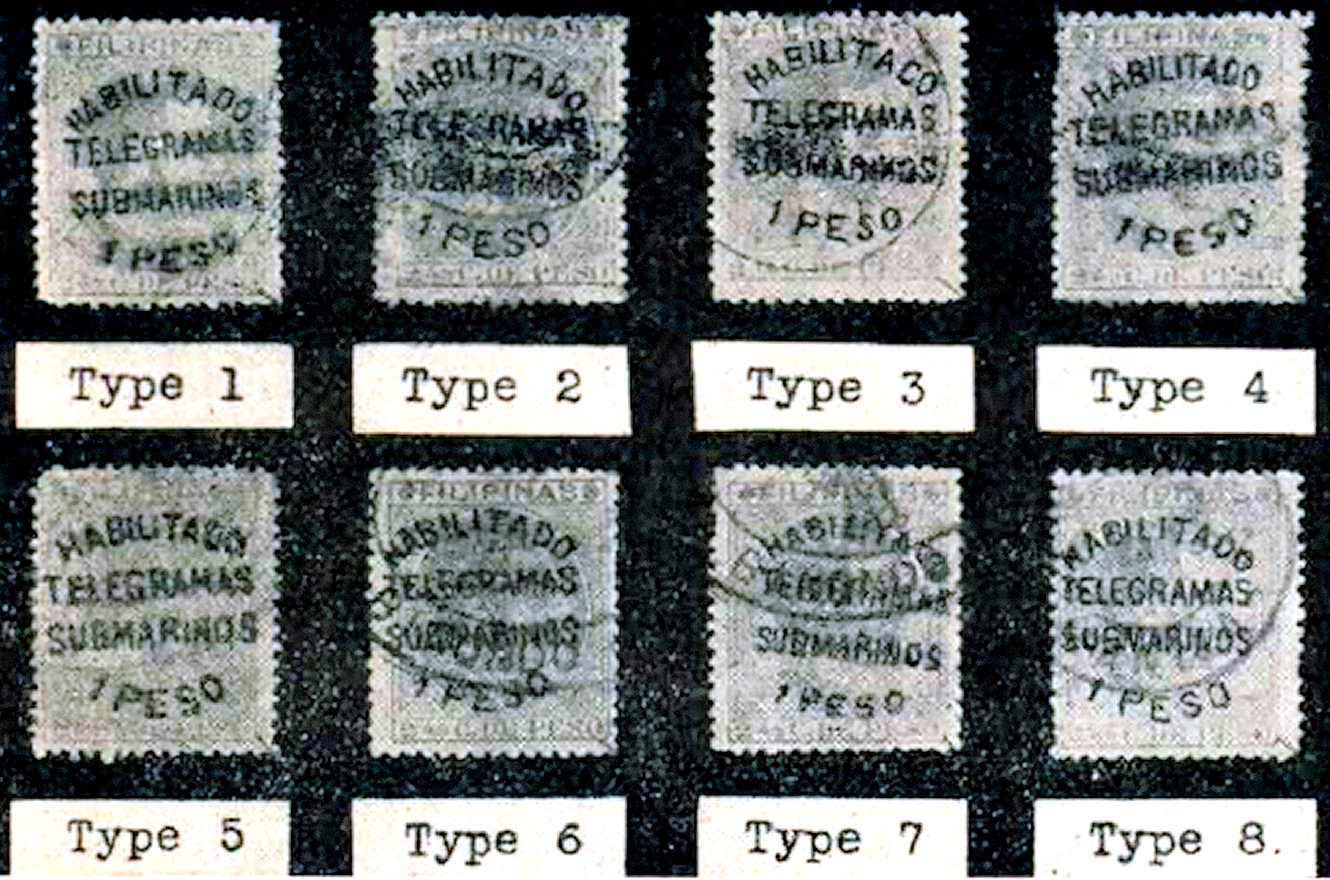
TYPE 5. The H of Habilitado is above the E of Telegramas. The H of Habilitado is fully 1.5 mm. wide, being much larger than in type 4. This surcharge is the largest of the eight types.
The word Submarinos is about 17.25 mm. long. The O of both Habilitado and Submarinos is wider and more rounded than in type 4. The letters ILIT of Habilitado are close
together and the vertical lines of these letters are nearly parallel, The G of Telegramas is noticeably taller and wider than in any other type. The ink used is the same as that used
for all preceding types and the letters present the same raised appearance. The lines of the letters are thin. This surcharge occurs on type II and, rarely, on type III of the stamp.
TYPE 6. The must distinguishing features of this surcharge are due to the kind of ink used for the surcharge. The color of the ink is a dull brick red. The ink was evidently rather “thin” so that
the surcharge presents a “flat” appearance. On many specimens the surcharge appears faded. The lines of the letters are noticeably thicker than in any of the preceding types, due
perhaps to the spreading of a thin ink. On most specimens this surcharge is rather carefully stamped, so that it is very legible. The serif of the 1 of 1 PESO is very Long, much longer
than in any other type. The H of Habilitado is above the T of Telegramas. The word Submarinos is about 15.75 mm. long. The final S of Telegramas and of Submarinos on many specimens
appears almost like a figure 8. The letter L of Telegramas leans to the left, a characteristic peculiar to type 6. The upper part of the P of Peso is almost circular. In all preceding
types that part of the P is flattened horizontally. This surcharge occurs on type II of the stamp. The writer has seen two stamps bearing double surcharges, both type 6.
TYPE 7. The letters of this surcharge are smaller than those of any other type and are quite irregular. The H of Habilitado is above the T of Telegramas. The word Submarinos is about 15 mm. long.
The final S of Submarinos is about one-half a letter to the left of the final S of Telegramas. In all other types the final S of Submarinos is directly below the final S of Telegramas.
The E of Peso is very irregular, the outer ends of the upper and lower bars being bent toward each other. The letters LI of Habilitado are short and very close together, and the vertical
lines of these letters are parallel. The lines of the letters are thick, The ink used is a dull brick red, apparently similar to that used for type 6. On most specimens the surcharge
appears to have heen very carelessly stamped, so that a portion, at least, of the surcharge is illegible. This surcharge occurs on type II of the stamp. Type 7, according to Dr.
Ricardo A. Reyes, is a forgery which was made by a student engraver and sold to the public in 1885 by his partner, Maxima Guerrero. The writer examined 183
specimens of type 7, all of which evidently had actually been used for telegraphic purposes.
TYPE 8. The ink used for this surcharge was a dark red “thick” ink, so that the letters are “raised” as in types 1 to 5, inclusive. The lines of the letters are heavier than those of types 1 to 5.
The H of Habilitado is above the T of Telegramas. The word Submarinos is about 15mm. long. The middle bar of the R of Telegramas is at the center of the letter. The middle bar
of the R of Submarinos is above the center. The upper bar of the first E of Telegramas is much longer than the lower bar. The upper half of the B of Habilitado is wider
than the lower half. On many specimens only the upper half of this B is legible. The letters LIT of Habilitado are rather far apart and the vertical lines are nearly
parallel, The N of Submarinos leans to the right. The B is very close to the first I of Habilitado. This surcharge occurs on all three types of the stamp, but is rare
on types I and III of the stamp. On most specimens the surcharge is very carelessly stamped so that a portion is illegible.
NUMBER OF SPECIMENS OF EACH TYPE EXAMINED.
The specimens of this surcharge examined by the writer were distributed among the several types as follows.
| Surcharge Type | Stamp Type | Number Examined | Percent of Total |
|---|---|---|---|
| 1 | I | 8 | 0.22 |
| 1 | II | 1892 | 51.78 |
| 2 | III | 19 | 0.52 |
| 3 | II | 454 | 12.43 |
| 4 | I | 1 | 0.03 |
| 4 | II | 305 | 8.35 |
| 4 | III | 7 | 0.19 |
| 5 | II | 153 | 4.19 |
| 5 | III | 1 | 0.03 |
| 6 | II | 432 | 11.83 |
| 7 | II | 183 | 5.01 |
| 8 | I | 1 | 0.03 |
| 8 | II | 196 | 5.36 |
| 8 | III | 1 | 0.03 |
| Total of all types. | 3653 | 100.00 | |
It is worthy of note that 2900 of the above represented the stock of one dealer and that among these 2900 not a single specimen of either type 6 or type 7 of the surcharge was found.
A great many of this lot of 2900 bore postal cancellations dated 1887 and 1888. On the other hand every specimen of both type 6 and type 7 of the surcharge bore the same type of cancellation,
the large oval telegraph cancellation of Binondo (Manila). Since Dr. Reyes states that type 7 is the forgery which appeared in 1885 we might possibly infer that type 6 also appeared about 1885,
altho the writer has no proof of this. Another curious fact is that in one dealer's stock of only 29 specimens the writer found 7 specimens of the rare type 2 surcharge. The writer therefore
believes that a number of varieties may be considerably more numerous than the above list would seem to indicate. It is also possible that there are additional varieties which the writer has not seen.
The writer believes, for example, that the type (b) surcharge listed by Galvez is the same as type 7 listed hy the writer. Galvez lists this type as occuring on type III of the stamp, but the writer
has not seen this variety.
CANCELLATIONS OBSERVED
The writer infers that all of the eight types of surcharge described above were actually used for telegraph and postal purposes because
on every specimen examined the cancellation had been applied AFTER the surcharge was applied.
No dated cancellations were found on types 6 and 7. In every ease the cancellation was the large oval telegraph cancellation of Binondo (Manila),
bearing in the center a star and broken arrows (thunderbolts).
Many dated postal cancellations occured on types 1, 2, 3, 4, 5, and 8. The dates of these cancellations are 1887 and 1888.
Three specimens of type 1 were found punched and bearing a cancellation consisting of a monogram which includes the letter T.
This double cancellation was at one time in common use on telegrams, altho later the use of the punch was prohibited.
The writer does not know the date on which the use of the punch was prohibited, but if this date on which the use of the punch was prohibited became known it
might indicate how early type 1 was in use.
A FORGERY MADE TO DEFRAUD THE PHILIPPINE GOVERNMENT
It is to be noted that the face value of this stamp was increased by means of the surcharge from 2⁴͏/͏₈ centavos to one peso.
This fact created an opportunity for profit which, it appears, was not overlooked by forgers of that time.
Dr. Ricardo A. Reyes, for many years a keen student of Philippine stamps, in July, 1937, wrote me substantially as follows:
(I do not quote his exact words because I do not have his letter before me as I write.)
“..... At that time (1885) a student engraver employed by Adolfo Garcia, Sr., proposed to an old woman (Maxima Guerrero} who sold stamps in the
Walled City (of Manila) that they could make money by placing forged surcharges on certain Philippine stamps of that period.
The first forgery they made was of the 2⁴͏/͏₈c. postage stamp surcharged HABILITADO TELEGRAMAS SUBMARINOS 1 PES ⁴͏/͏₈ centavos for a genuine postage stamp and after placing on it a forged surcharge sold it for one peso. Perhaps you know that there are two types of this surcharge:
one large and regular, the other small and irregular. The small and irregular type is the forgery that they made. They succeeded so well in selling this forgery to the public that they then
proceeded to imitate most of the surcharged stamps which were then in use. In 1888 their activities were discovered and they were sentenced to Bilibid (Manila) prison for forgery.
Many of the forgeries which they made were sold to the public and were actually used for telegraph and postal purposes. I believe that forgeries which were actually used for postal and telegraph
purposes may be included by the collector in his collection, especially in used condition. Some collectors do collect them.”
I did not give much thought to the above portion of Dr. Reyes' letter for some time.
But in May, 1938, I sent to him for examination six specimens of the surcharge HABILITADO TELEGRAMAS SUBMARINOS 1 PESO.
Two of these specimens, which I numbered 3 and 4, I inferred to be the forgery which Dr. Reyes had described in his letter of July 27, 1937.
On May 14, 1938, Dr. Reyes replied as follows:
“I have received your letter of the 9th of May with the six stamps surcharged “Telegramas Submarinos”, which I return to you attached hereto.
You are right. Nos. 3 and 4 are the forgery of Maxima Guerrero of 1885-86 of which I spoke to you in my letter of July 27, 1937.
Note that the letters are smaller than in the other types and that the letter S of PESO has the lower curl very small.
“This forgery was discovered in 1886 and was the object of an investigation, as the result. of which various persons entered Bilibid (Prison).
“I attempted to find the record in the General Archives, but I did not find it; the official in charge of the records did not know what had become of this record.
“As a result of the discovery of this forgery, when in 1887 the Government ordered the die to be made for 2⁴͏/͏₈ centimos (Scott Type A-25 & A-35),
the engraver, Don Adolfo Garcia, made a more perfect die, of oval shape, the letters “HABILITADO” with serifs and more finely executed.
This surcharge was more difficult. to falsify (Scott’s Nos. 107 up to 111, 130, 131 and 136) and as a result I do not know of any forgery of this surcharge.”
By way of further explanation it is to be noted that in order to make supplies of postage and telegraph stamps more conveniently available to the public
the Philippine Government of that period (1881-88) authorized small storekeepers in various parts of the city of Manila to sell postage and telegraph stamps.
Such authorized stamp vendors were called ‘‘estancas’’. Maxima Guerrero was an authorized stamp vendor whose store was located in the Walled City.
She therefore provided the facilities for selling the forgeries which were made by her partner, the student engraver.
The forgery above described by Dr. Reyes is listed by the writer as type 7. Since this forgery was actually used for telegraphic purposes we believe that it has a legitimate place
in any catalogue of Philippine telegraph stamps. It should he listed, however, as a forgery made for the purpose of defrauding the Government.
The large number of types of this surcharge encountered by the writer naturally raises the question as to whether or not there was more than
one type of forgery made and sold to defraud the Government. Probably we shall never be certain about this.
But we do know that, whether genuine or forgeries, at least eight types of this surcharge were actually used for postal and telegraphic purposes.
FORGERIES MADE TO DEFRAUD THE STAMP COLLECTOR
To the stamp collector a forgery is an imitation of a stamp made for the purpose of defrauding the stamp collector.
The word, as applied to stamps, has acquired this special definition because forgeries of stamps made for the purpose of defrauding a Government are exceedingly rare.
As a rule, forgeries made for the purpose of defrauding the stamp collector are imitations of rare and costly stamps. But, such is not always the case.
The writer has seen forgeries of a number of very common Philippine stamps, stamps so cheap that it may well be doubted whether the total revenue which could be
obtained from the sale of the forgeries would pay the cost of producing the forgery.
The writer makes no attempt to explain the motive for making such forgeries. He merely records their existence.
Of this latter category are two different forgeries of the surcharge, “HABILITADO TELEGRAMAS SUBMARINOS 1 PESO”. Since genuine specimens sell at from
five to fifteen centavos each it is difficult to find an adequate motive for making the forgeries.
The writer concludes, however, that these two forgeries were not made for the purpose of defrauding the Government because the surcharge was in each case
applied AFTER the stamp was cancelled. These two forgeries could not, therefore, have heen used for postal or telegraph purposes. These two forgeries are described as follows:
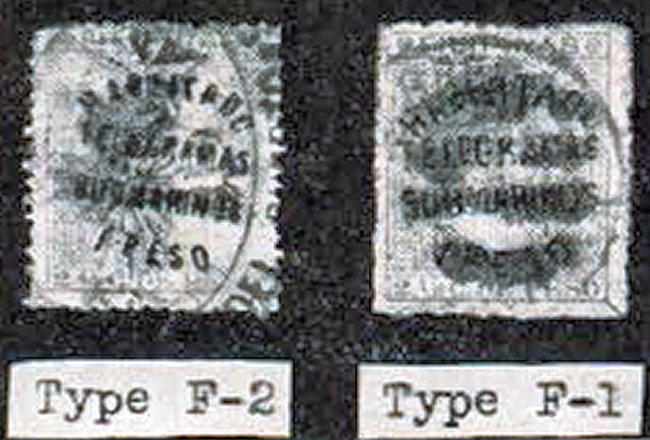
Type F-1, This surcharge appears to have been drawn with pen and ink. The letters are very irregular. The O of Submarinos is very wide.
The M of both Telegramas and Submarinos has vertical outside lines.
Ten of these hand-drawn forgeries were encountered, no two of which were exactly alike. All of them were on type III of the stamp.
Type F-2. The letters of this forgery are very small and narrow. The letters are very far apart. The word Submarinos is barely 13.5 mm. long.
The words 1 PESO form an almost straight line.
Six specimens of this forgery were encountered, all of them on badly faded specimens of type II of the stamp.
My comments on this: A forger would probably produce a single copy of a handstamp to produce multiple fakes in a labour-intensive manner.
This would probably cause many poor examples, but at least they should be fairly consistent.
Christian Preuße in the 2nd. Quarter 2024 PPJ showed a block of four of the genuine surcharge. they were laid out with consistent separation vertically and horizontally as well
as nicely horizontal. Presumably they were applied a sheet at a time by machine. There are though some minor differences between the images.
Look at the first "S" of "SUBMARINOS", the bottom upward curve varies, as does its vertical relationship to the following "U".
It may be that a number of different "Types" are all perfectly genuine. Images of other blocks are needed to determine their variability.
Forgeries may have been done with all manner of handstamps that may have distorted on impact.
The few examples that I have images of are difficult to match to these eight types, as are Hiscocks' illustrations.

 The backwards N looks like it might be Type 2 or 3, but the R of Submarinos seems to rule out Type 3. But the D of Habilitado does not match Type 2. Stamp type 2. |  This looks like Type 1 to me, going by the letters "HAB" of Habilitado and final letters of other words. Stamp type 2. |
 I think this must be Type 1, although the "G" doesn't look quite right. My second choice was Type 6, but that "G" doesn't look right either. Stamp type 2. |
 The ink on this looks like it has a 3D effect suggesting the thick ink of types 1 to 5 and 8. Of those, it most closely matches Type 8, except the B is NOT close to the first I of Habilitado |  This looks like Type 7 to me. Most of "PESO" seems to have "bounced". Stamp type 2. |
I would like to replace the original images with new colour images that can more easily be seen.
Some of them are very rare, but if I can at least get images of the more common types it will help people to sort them out.
I would therefore ask anyone that can send me images of these to do so please.
"They succeeded so well in selling this forgery to the public that they then proceeded to imitate most of the surcharged stamps
which were then in use."
It would have been pointless to forge the 1 centavo or 2⁴͏/͏₈ centavos, but there is a known forgery of the 20c and evidence for forgeries of the 5c so far.
1885-1887 Postage stamps of 1880-82 (SG 95 and, in one case SG 94) overprinted and surcharged in various types and colours as indicated below.
White wove paper. No watermark. Perf. 14
These were created by a decree of 2 March 1886 for Telegraphs: 1c, 2⁴͏/͏₈c, 5c(carmine) and 20c(black).
For this "four seals, engraved in bronze, were to be made and their application were to be expressed in different inks."
A further decree of 11 September 1886 for Telegraphs: 1c, 2⁴͏/͏₈c, 5c(brown), and 20c(red); and UPU (Postal): 1c and 10c.
For this "six bronze seals will be made each expressing in different inks the new intended designation.", giving 10 hand-stamps in all.
That gives Hiscocks' illustrations below, plus another 5c for H17 and another 25c for H21.
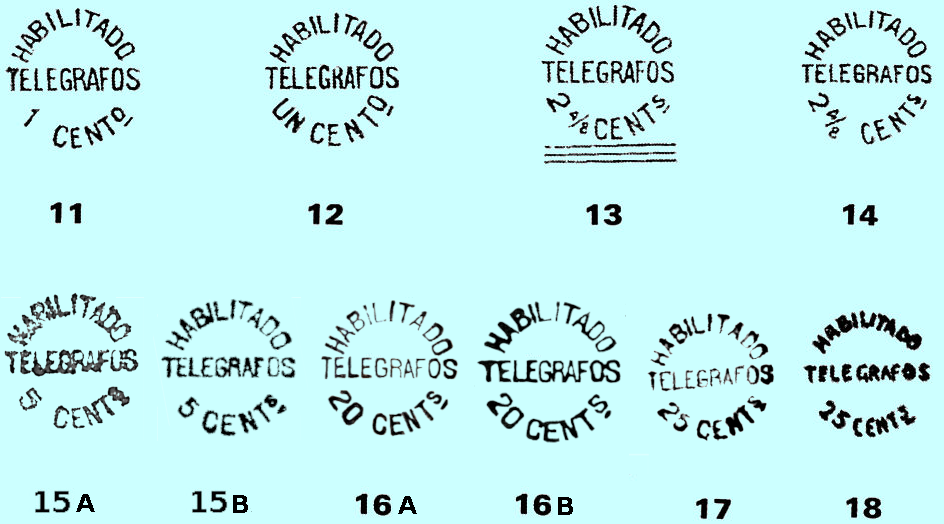
Types 11-18 from Hiscocks book page 244 with the bottom row revised.
| RH # | Hisc. | Type. | Description | Mint | Used |
|---|---|---|---|---|---|
| RH12 | H12 | 6, 9, 11 | 1c on 2⁴͏/͏₈c dull ultramarine in violet | 2.00 | 1.00 |
| RH13 | H13 | 6, 9, 12 | 1c on 2⁴͏/͏₈c dull ultramarine in black (Jan. 1887) | 20.00 | 8.00 |
| RH14 | H14 | 6, 10, 12 | 1c on 2⁴͏/͏₈c dull ultramarine in black (Jan. 1887) | 2.00 | 1.00 |
| RH15 | H15 | 6, 9, 13 | 2⁴͏/͏₈c on 2⁴͏/͏₈c dull ultramarine in carmine (7.3.86) | 2.00 | 1.00 |
| RH16 | H16 | 6, 10, 14 | 2⁴͏/͏₈c on 2⁴͏/͏₈c dull ultramarine in dark blue (11.9.86) | 2.00 | 1.20 |
| RH16a | H16a | overprint in black | 4.00 | 2.00 | |
| RH17 | H17 | 6, 9, 15A | 5c on 2⁴͏/͏₈c dull ultramarine in carmine (7.3.86) | 2.40 | 1.00 |
| RH18 | H18 | 6, 10, 15B | 5c on 2⁴͏/͏₈c dull ultramarine in brown-yellow (Jan. 1887) | 3.00 | 1.00 |
| RH19 | H19 | 6, 9, 16A | 20c on 2⁴͏/͏₈c dull ultramarine in black (7.3.86) | 4.00 | 2.00 |
| RH19a | - | 6, 9, 16A | 20c on 2⁴͏/͏₈c dull ultramarine Forgery | - | 20.00 |
| RH20 | H20 | 6, 10, 16B | 20c on 2⁴͏/͏₈c dull ultramarine in vermilion (Jan. 1887) | 4.00 | 2.00 |
| RH21 | H21 | 6, 9, 17 | 25c on 2⁴͏/͏₈c dull ultramarine in carmine (10.9.85) | 20.00 | 4.00 |
| RH22 | H22 | 6, 9A, 18 | 25c on 25c brown (SG94) in green (24.2.85) | 15.00 | 2.00 |
I have revised/added images 15A to 17 to help identify overprint forgeries that were intended to defraud the Government.
Some dates have been revised in light of new information.
 January 1887 on stamp type 3. Long top to "F" ? |  “short-waisted" R (like Type 3 Submarinos). | 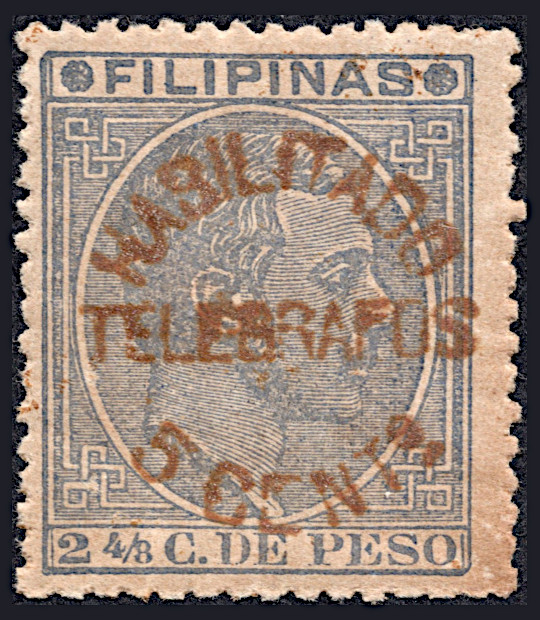 “F different" courtesy of Mike Palmer, top of 5 long. |
Minor differences between these 5c H18 stamps. If any are forged, then the forger did amazingly good work on most of it, too good to make the small slips seen.
So what does make the small differences ? As an aside, there was no point forging the 1c, 2⁴͏/͏₈c on 2⁴͏/͏₈c or 25c on 25c stamps, so how constant are they ?
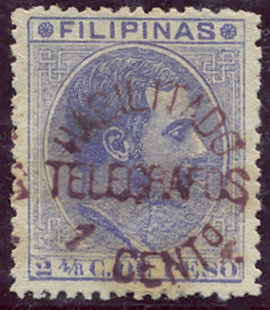
 H12: "F" looks a bit different, and how about the "1 CENTo" ? The "NT" height? (right from NVK) |

 These at least look fairly similar. Left one of mine, right from NVK Stamps on eBay. |
So why are there differences if there is no reason to forge them?
Certainly over-inking or under-inking will make differences, it is also likely that the handstamp will get some clogging from dried ink,
but at least some of the differences do not seem to be due to any of those.
The stretched 1 Cento looks like the result of a rubber handstamp rather than brass !
Did the postal workers also not see the point of wasting good brass on them despite authorization ?
What of the "F" on the 5c above though. That looks like brass was used, but perhaps the "F" needed to be repaired at some stage.
It would be possible, at least in principle. Solder could be added and surplus filed or cut away. Subsequent impressions would be different.
Dated examples might show a pattern.
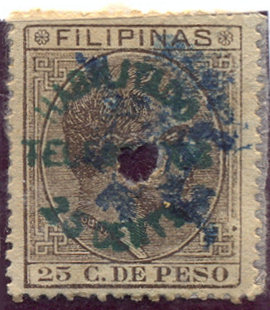
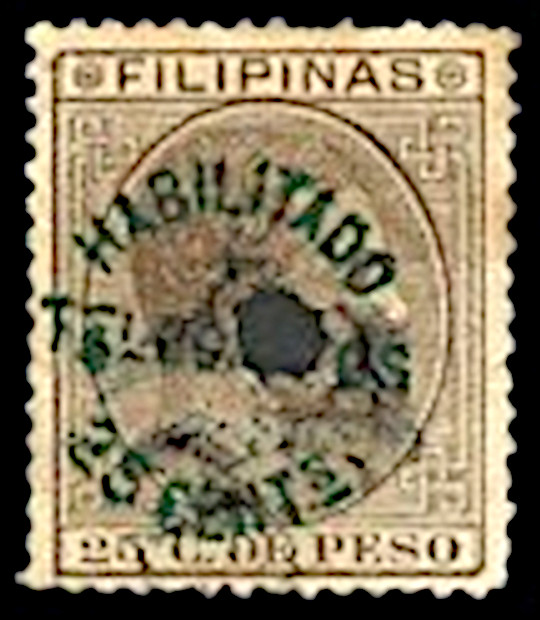
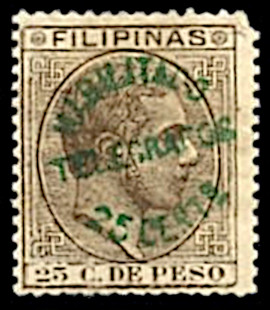 H22: Some differences that might be down to a poor image, or was that rubber too ? Actually these are earlier, 24 February 1885 with an un-retouched head. |
The Left-hand stamp from RL, the right-hand stamp is another poor image from
NVK Lot 753.
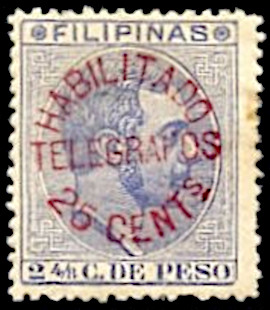
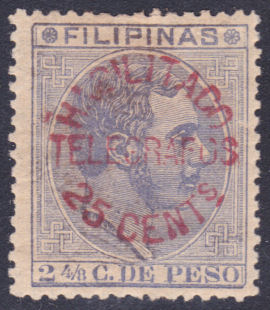
From the point of view of early lucrative forgery prospects, H21 has to be high on the list, with 25c on 2⁴͏/͏₈c from 10.9.85, but they appear to be scarce.
Perhaps few were used, with little demand.
 |
 |
 |
| H21 Two examples from the NVK Auction. | H21 Courtesy of Mathew Stephenson. |
|
These all look convincingly similar, on the right kind of stamp, and Genuine.
Just the kind of stamp to be forged to defraud the collector !
The 20c on 2⁴͏/͏₈c ought to attract forgery. The top two look good.
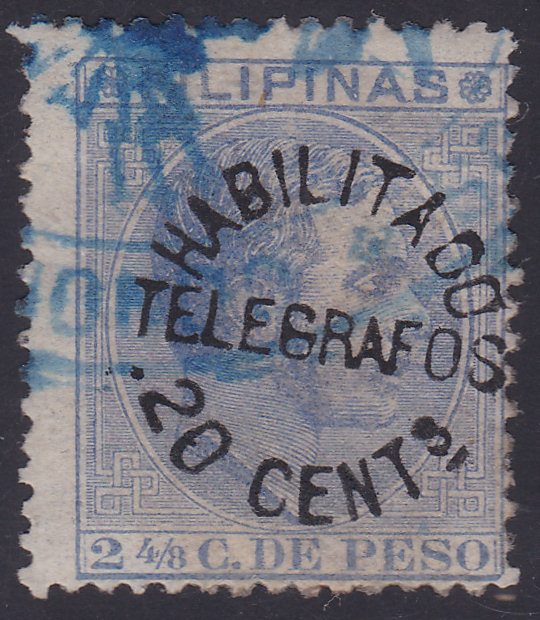
 7 March 1886 to January 1887 on stamp type 2. I think probably genuine, though the D looks taller on the right-hand stamp. |
But there was at least one type of forgery.
 A known forgery. Compare with above and look at the "20". |
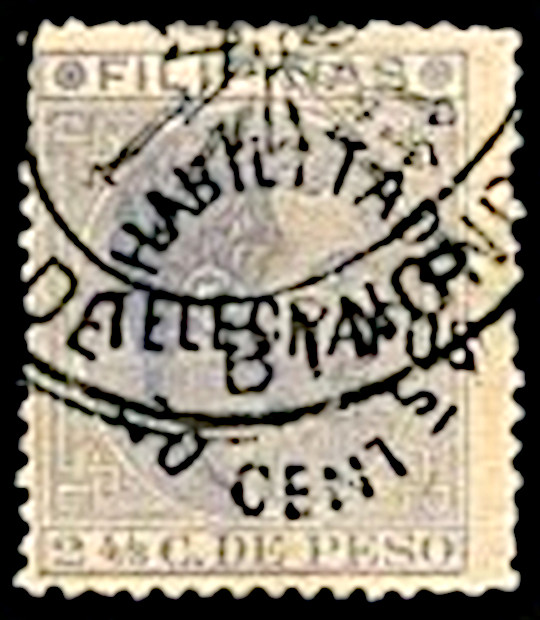 Another example from NVK Lot 753 |
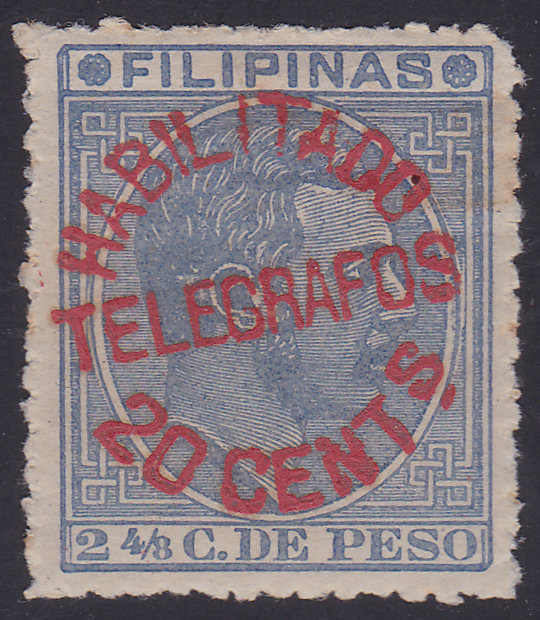 H20, larger in red. This is genuine. |
This shows a 20c forgery to defraud the Government. Left image courtesy of
Mike Palmer.
I have not seen any suspicious-looking red 20c overprints as yet.
The black forgery is not very good, perhaps they thought that red would make their fakes too obvious.
An article from "Le Timbre-Poste", No.427, 1898, Pg.102. Published by Jean-Baptiste Moens of Brussels.
|
The postage stamp of 2⁴͏/͏₈c. of peso had barely come into use, in February 1882, that it
2nd TYPE [Warren Type 6 ?]
3rd TYPE [Warren Type 5 ?]
4th TYPE [Preuße Type 1d ?]
5th TYPE [Warren Type 1 or 8 ?]
6th TYPE [Warren Type 7 ?]
It is possible that more types exist. |
Another very suspicious item :
 |
 |
 |
 |
 |
| F1 (Forbin 30) Courtesy of Rolf Lamprecht |
F2 (Forbin 31) Courtesy of Mike Palmer |
F3 (Forbin 32) Courtesy of Rolf Lamprecht |
F5? - (inverted overprint) Courtesy of LiquidationGirl on eBay |
Bogus, 17⁴͏/͏₈c on 10c |
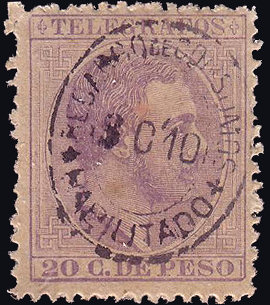
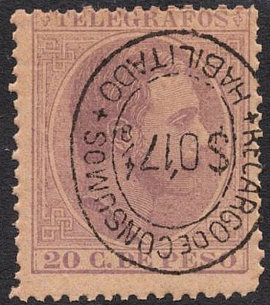
The images of F1 to F3 above are thought to be genuine, although there are known differences in style, like the relative sizes of the different words.
There would be no way to defraud the Government by forging them. The same should be true of the last two, but strangely the only ones I have seen are either inverted or on the wrong stamp.
Nicely clear impressions are also unusual. As stamps that would on the face of it be rare though, they could defraud the collector.
Again, I would ask anyone that can help with this to do so please.


