| अनुवाद |
Übersetzen sie |
WORKING
|
Traduisez |
ترجم |
| перевести |
Traduca |
Traduzca |
翻译 |
|
Telegraph stamps of the World
Click here for a site-map. |
Select currency. Default = GBP (1.0)
|

Siam/Thailand.
These were previously in the Miscellaneous page, but since they at least had proofs, they are on an equal footing with Italy and deserve their own page.
Thailand used the Lunar Chula Sakharat calendar, based on an old Burmese system (CS 1245 = CE 1883) until 1888.
In 1888, King Rama V changed to the Ratana Kosin Sok calendar, based on the start of the Chakri Royal dynasty. (RS 108 = CE 1889).
In 1913, the Buddhist calendar was introduced (BE 2500 = CE 1957). Thus you need to subtract 543 years from Buddhist dates.
(My thanks to Jos Sanders for this)
According to Jos Sanders :
The telegraph was introduced in Thailand (then Siam) in 1875 during the reign of King Rama V.
The country's first telegraph line was deployed by the Ministry of Defence, connecting the capital city of Bangkok to the coastal port town of Samut Prakan (Paknam).
Early Timeline of the Thai Telegraph:
1875: The first telegraph line opened between Bangkok and Samut Prakan.
1878: A second telegraph line was extended from Bangkok to Bang Pa-in in Ayutthaya.
1883: King Rama V formally established the combined Post and Telegraph Office. [1, 2]
Early Timeline of Siam's International Connection :
1883: The Siamese government completed an overland telegraph line that connected Bangkok to Saigon (the capital of French Cochin-China, modern-day Vietnam).
Global Access: By linking to Saigon, Siam hooked into the extensive undersea network operated by the British Eastern Extension, Australasia & China Telegraph Company.
This allowed Siam to send and receive telegrams globally for the very first time.
1885: Just two years later, Siam expanded its regional connectivity by opening another international line to Tavoy (Dawei) in British Burma, linking the country directly into the British imperial communication network.
The telegraph service in Thailand stopped April 30, 2008.
|
Said to be Circa 1880, but appears to be modelled on the 1890/1902 stamps of India.
Unissued samples of Telegraph stamps, intended to have face values of 2 and 3 Atts.
The design suggests that they were to be used in a way similar to the double-headed issues of India.

Unique stamp essays for sale in the upcoming Eurseree auction, Sale 65, lot 5A.
Listed with a starting bid of baht 800,000 or about $22,200.
These are essays, printed by Giesecke DeVrient in Germany for Thailand Telegraph stamps, which were never actually issued. Some part of the design shows similar features as long green Court Fees,
also printed by Giesecke DeVrient. Value on the essay is 2 Atts, indicating they are printed before 1908 when the currency changed to Satang.
A few years ago, Rory Morrisey found in the archives of Giesecke DeVrient a proposal for Siam Telegraph stamps but there was no other information and no contract that could be found.
The proposal was dated April 21, 1906, and was for 70 million Telegraph stamps with values from 1 Att to 50 Ticals in 19 different values.
No price was given but it must have been a huge possible contract.

|
Before 1909, the currency was quite complicated. The Scott Catalogue gives 32 Solot = 16 Atts = 8 Sio = 4 Sik = 2 Fuang = 1 Salung, and 4 Salungs = 1 Tical.
That goes some way to explaining why they wanted 19 different face values, compared to India with only 10.
In 1909 it was simplified to 1 Tical = 100 Satangs.
Stationery.
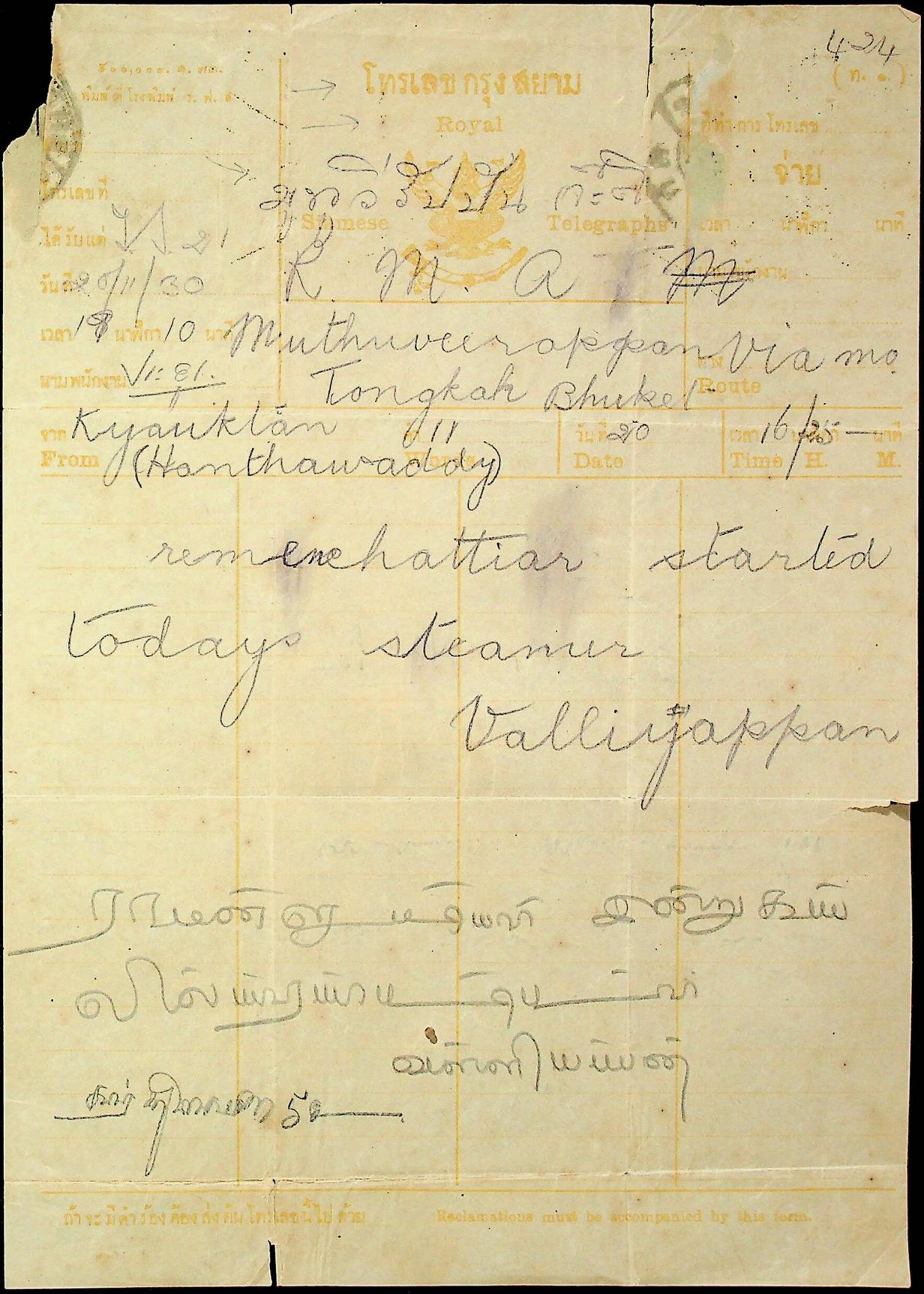
The Telegraph Delivery forms are unfortunately printed in yellow making them hard to read. I have seen 2 different types, but there may be more.
 |
|
This has extra writing at top-left.
 |
An undated telegram form from eBay. Unfortunately I do not know who to attribute to.
If you, then please get in touch. |
|
A telegram form dated 20 Novenber 1930. I don't really know if that is earlier or later than the one to the left.
Image courtesy of Sephils.com |
A much more recent telegram and envelope.

Luckily part of the imprint on the telegram is showing. If we assume the 2506 is the year of printing , then by the Western calender, 2506 - 543 = 1963.

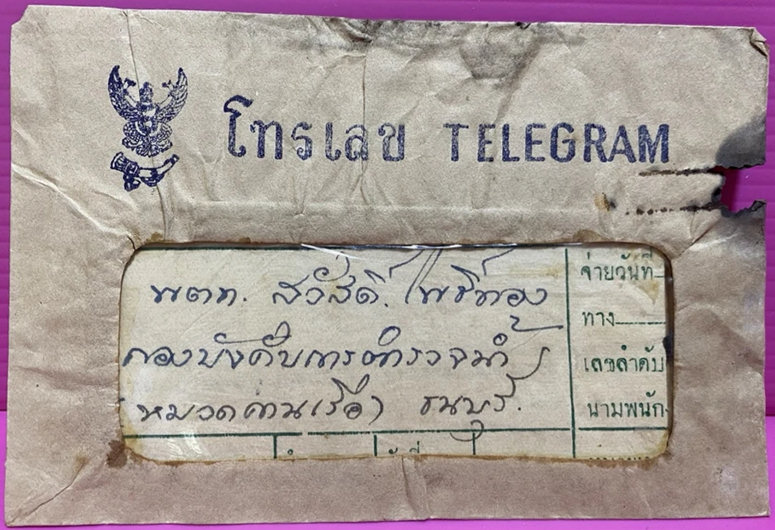

Envelope front and back. These images are taken from eBay lots of JadeSoda.
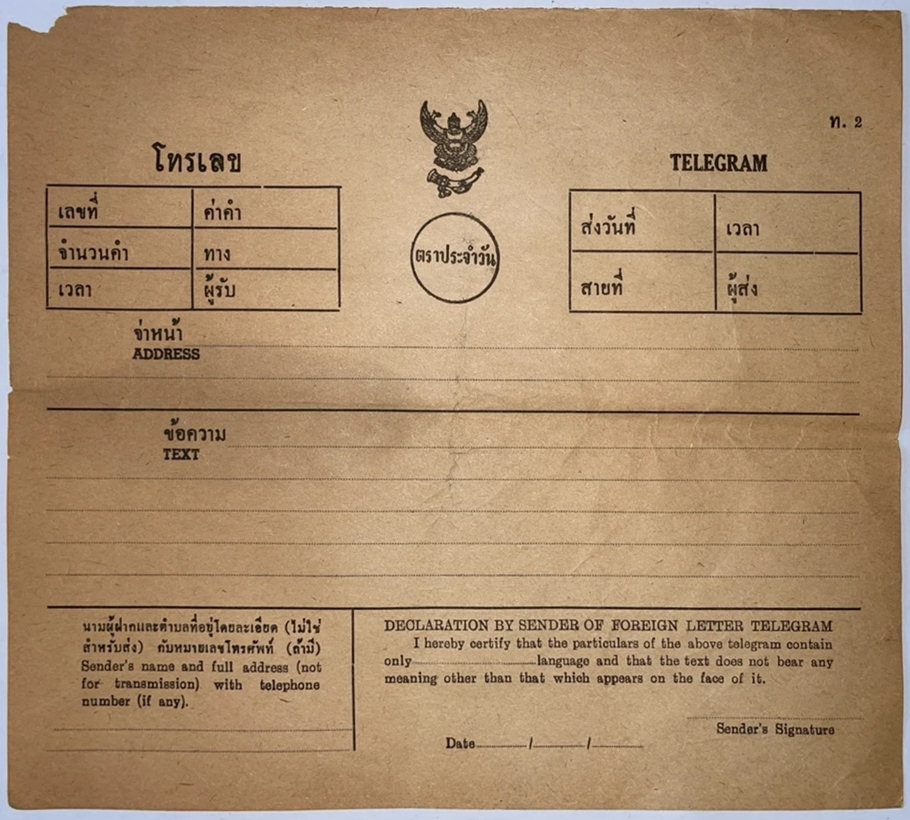
Unused Telegraph Sending forms. I have seen 2 different types, but there are probably many more.
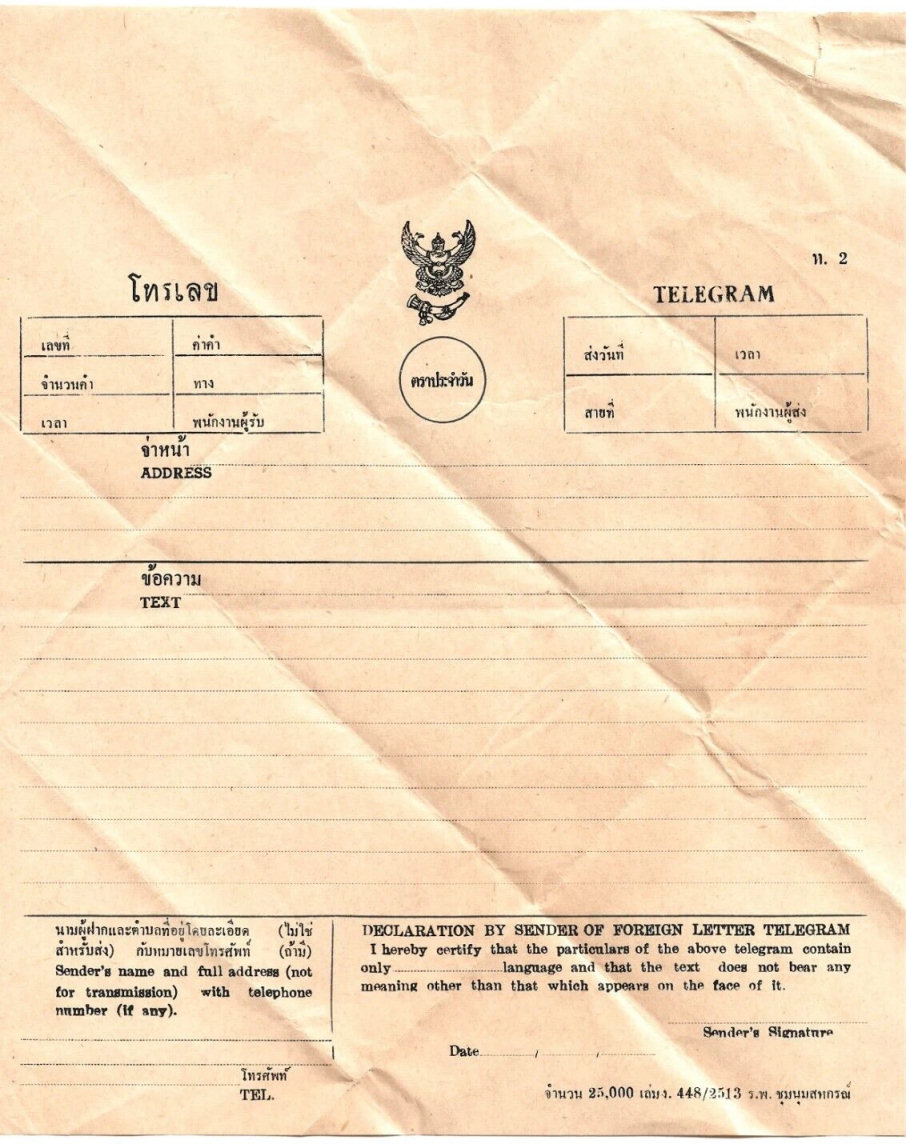 |

The form on the left has an imprint with the number 2513, suggesting a printing date of (2513-543) = 1970.
These images are taken from eBay lot of OptimaStampsandCollectables
The one below has no imprint, but the same form number at top-right (2). Such forms generally get shorter over time,
so I assume the one below is later.
This image is taken from eBay lot of PopplestonesCollectables
|
 |
No issued Telegraph stamps, but they did have telegram seals,
most of which had clear symbolism of Thailand.

 |
 |
A range of seals are known and shown in the section on seals.
As always, If anyone can provide further information and/or scans to help with this page, I am happy to give appropriate credit.